

From Classroom Learning to SAP Certification: Building Enterprise Readiness Across Finance and Operations
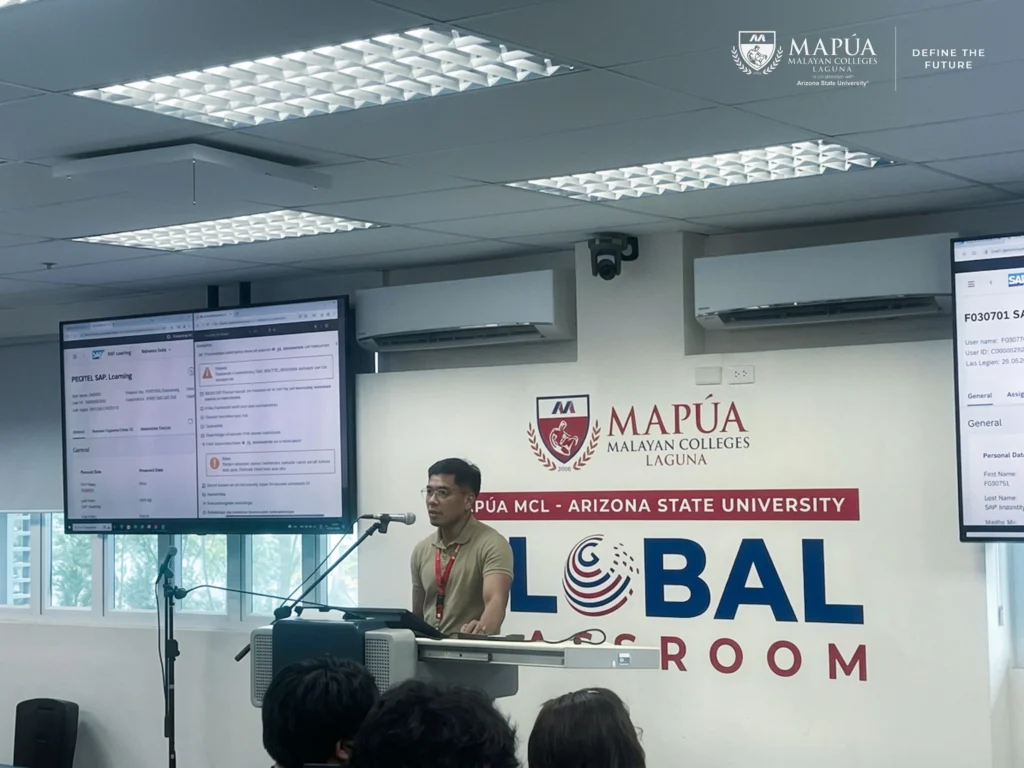
In line with the recommendations of the Program Advisory Panel (PAP), Mapúa Malayan Colleges Laguna’s (Mapúa MCL) E.T. Yuchengco College of Business (ETYCB) implemented an Enterprise Resource Planning (ERP) SAP Training Program for students enrolled in C-FIN118 ETY351: Special Topics in Financial Management and C-OPM118 ETY361: Special Topics in Operations Management. The initiative served students from the Bachelor of Science in Business Administration (BSBA) Financial Management and BSBA Operations Management programs and was designed not simply as an enrichment activity, but as a rigorous, applied learning requirement.
Proposed and organized by Prof. Noel Eric B. Ang, the program made professional SAP certification the culminating requirement for the courses’ Module 1 Assessment. Students were required to complete and pass the SAP Certified Implementation Consultant – End-to-End Intermediate Level certification. This requirement gave the module a clear end goal: students were expected not only to understand ERP concepts in class, but also to demonstrate that they could apply end-to-end enterprise-process knowledge in an actual SAP learning environment.
The initiative was strengthened through the generous collaboration of Mr. Rendel Edison Sinag, SAP Training Systems Consultant and ETYCB professor. Drawing on his expertise in enterprise technology, ERP systems, business intelligence, data analytics, and systems training, Mr. Edison helped students understand the practical discipline behind SAP processes and certification preparation. His contribution was particularly commendable because he willingly devoted his personal time to support the students and the program on a voluntary basis. ETYCB extends its sincere appreciation to Mr. Edison for his generosity, professional commitment, and belief in preparing students for real workplace demands.
The ERP SAP Training Program was intentionally designed to give each student group a discipline-specific perspective while reinforcing the shared nature of enterprise operations.
For BSBA Financial Management students, the lessons emphasized how ERP supports Financial Accounting and Controlling functions. Students examined the relationship between financial reporting, cost centers, profitability, asset management, reconciliation, compliance, and timely management information. They learned that ERP transforms finance from a largely retrospective reporting function into a source of real-time, decision-relevant insight. The learning materials also introduced the importance of data quality, audit trails, cloud ERP, predictive analytics, and the changing role of finance professionals in AI-enabled organizations.
For BSBA Operations Management students, the learning experience centered on the interconnected processes that keep an organization moving: procurement, materials management, inventory control, production planning, quality management, plant maintenance, and supply-chain coordination. Students explored how ERP can help organizations reduce stockouts, improve capacity planning, manage quality issues earlier, strengthen maintenance decisions, and create visibility across the entire operational flow. Concepts such as material requirements planning, bills of materials, routing, reorder points, and Kanban were connected to the digital systems that make modern operations more coordinated and responsive.
The SAP certification requirement made these concepts tangible. Students had to navigate structured business processes, follow the correct transactional sequence, troubleshoot errors, and appreciate the consequences of incomplete or inaccurate entries. In an ERP environment, one missed action or incorrect posting can interrupt a succeeding process, affect inventory records, delay billing, distort costs, or prevent an operational transaction from moving forward. The assessment therefore measured more than technical familiarity; it required focus, discipline, systems thinking, and attention to detail.
The reflections of the students demonstrate the impact of the experience. Jillian, from Financial Management, shared that the training initially seemed complex and intimidating, but repeated practice helped her understand the logic behind each business process rather than simply follow instructions. She came to appreciate the precision expected in enterprise work and the way a single transaction can influence other parts of the organization.
For Jasmine, from Operations Management, the opportunity to use SAP made the activity feel closer to real work than to an ordinary classroom exercise. She described how the certification challenged her, built her confidence, and gave her a professional credential she can include in her résumé and portfolio. More importantly, she recognized that the experience gave her a meaningful step toward the career she hopes to build.
This initiative is groundbreaking because it moves beyond the conventional model of discussing ERP in theory. By requiring students to pursue and pass an SAP certification as part of their Module 1 Assessment, the courses establish a direct connection between academic learning and a recognized professional standard. Students do not merely learn what an ERP system is; they experience how enterprise systems require accurate data, disciplined process execution, cross-functional coordination, and accountability.
The program is also significant because it brings Finance and Operations Management students into a shared enterprise perspective. Financial records, inventory movements, production activity, customer transactions, supplier payments, and management decisions are not isolated events. They are interconnected parts of one business system. Through SAP, students were able to see how their respective fields contribute to the same organizational objective: making sound, timely, and data-informed decisions.
Ultimately, the ERP SAP Training Program demonstrates ETYCB’s commitment to developing graduates who are not only knowledgeable in their disciplines, but also ready to adapt to the digital systems and integrated processes of contemporary organizations. It is a strong example of how academic initiative, faculty collaboration, and industry-relevant expertise can create learning experiences that are challenging, practical, and genuinely career-building.